Beyond the Water Heater: Managing Legionella Risk in Commercial Hot Water Systems
Key Highlights
- Maintaining hot water temperatures at or above 140°F in storage and 120°F in circulation is essential to inhibit Legionella growth while managing scalding risks
- Proper design and balancing of recirculation systems ensure consistent water temperatures throughout the building, reducing stagnation and bacterial proliferation
- Minimizing stagnant water involves avoiding oversized piping, capped branches, and low-use fixtures that can harbor bacteria and biofilms
Legionella can present a serious health risk in commercial buildings, yet the source of exposure may not always be obvious. The bacteria can grow within a building’s domestic hot water (DHW) system when conditions allow, making the plumbing infrastructure an important part of the prevention conversation.
Reducing the risk of Legionella growth in a commercial hot water system involves more than selecting the right water heater. Legionella thrives in warm, stagnant water, so the design and installation of the DHW system are equally important.
Commercial contractors should consider how water moves throughout the building, including proper pipe sizing, system layout, recirculation, and balancing.
Three Key Installation Considerations for Minimizing Legionella Risk
1. Maintain Proper Temperatures Throughout the System
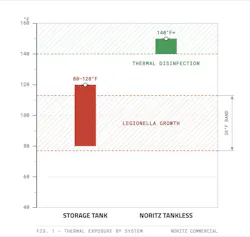
Temperature is one of the most important considerations when designing and installing a commercial DHW system. Legionella can grow over a relatively broad temperature range, with growth most favorable between 77°F and 113°F. According to the Centers for Disease Control and Prevention, hot water should be stored about 140°F, while hot water in circulation should not fall below 120°F. The World Health Organization reports that approximately two minutes at 140°F can result in a 90% reduction of the studied bacteria, while at 160°F and above, Legionella can die within seconds.
The exact operating temperatures for a commercial system should be determined based on applicable codes, standards, engineering requirements, and the building’s water management plan. Of course, system specifiers and contractors also must account for scalding risk when higher water temperatures are used.
The key point: Setting the water heater to a particular temperature does not guarantee that the same temperature will be maintained throughout the building. Contractors should look for areas where water temperatures may drop, particularly portions of the system that do not maintain at least 120°F. Proper pipe insulation can help prevent significant temperature losses as hot water travels through the distribution system.
2. Design and Balance Recirculation Properly
A properly designed and balanced recirculation system plays an important role in maintaining consistent temperatures throughout a commercial hot water system.
The recirculation line should maintain the temperature for which the system was designed. Contractors should verify that balancing valves are functioning properly and that water is being distributed throughout the system as intended.
An improperly balanced system can result in some branches receiving adequate flow at the right water temperature while others experience insufficient circulation.
In applications such as restaurants, a recirculation system should maintain above 120°F, while mixing devices at individual fixtures temper water to an appropriate delivery temperature and provide scald protection.
This approach illustrates why Legionella risk management cannot be viewed solely as a water heater issue. The water heater may produce the required temperature, but the DHW distribution system must maintain it.
3. Minimize Stagnant Water
Stagnation is another critical consideration. Oversized piping increases the volume of water contained within the system, which can increase the amount of time water remains in the piping before being used or circulated.
Capped or abandoned branches can create similar conditions. Although a branch may no longer serve an active fixture, it can remain connected to the system and contain stagnant water.
Low-use plumbing fixtures also deserve attention, particularly if located at the end of a branch. During installation and commissioning, contractors should ask building owners which fixtures are rarely used and assess whether water in those locations could become stagnant.
This is especially important in commercial facilities where building occupancy and water use can vary significantly. A plumbing system that performs properly under normal operating conditions may have different characteristics in areas that see little or only intermittent use.
Storage Tank vs. Tankless Systems
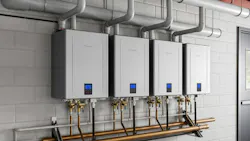
Storage-tank and tankless water heaters differ in how they handle hot water, of course. Storage systems keep heated water available in a tank, while tankless systems, such as the Noritz NCC199CDV Commercial Condensing Tankless Water Heater, heat water on demand; that is, as the water passes through the unit, rather than maintaining a large volume of hot water.
Because water remains in a storage tank between uses, periods of low demand can increase the time it is held within the system. Depending on storage temperatures, the tank can create conditions that support Legionella growth. Sediment and scale can also contribute to environments conducive to biofilm development. Tankless systems, by definition, limit the amount of water held within the heating equipment. That, in turn, should reduce opportunities for Legionella growth within the unit.
However, using a tankless system does not eliminate the risk throughout the building. As noted, stagnation and favorable temperatures can still occur in the piping, fixtures, and the recirculation system.
For contractors, the type of water heater is only one consideration when addressing Legionella risk. The hot-water distribution system must also be designed and maintained to support proper temperatures and water movement.
Evaluate and Test the Entire System
Replacing an existing commercial water heating plant presents an excellent opportunity to evaluate the condition and performance of the entire DHW system. Because no particular type of water-heating equipment, tankless or storage, prevents Legionella, the CDC identifies routine legionella testing over time as the best method for validating a water management program. We recommend following these steps.
1. Check the recirculation line to confirm that it maintains the intended temperature. Verify that the balancing valves are working properly.
2. Walk the system, checking the fixtures throughout the building. Pay particular attention to those farthest from the water heater. These fixtures can help identify whether an adequate temperature is being maintained throughout the distribution system.
3. Identify rarely used fixtures and ask building owners or facility maintenance personnel which fixtures are rarely used. A fixture that appears normal during commissioning may still represent a potential stagnation point if it receives little use after the building is occupied.
4. Look for cross-connections that could allow cold water to mix with hot water. Identifying and correcting these conditions can help the system maintain its intended temperatures.
5. Recommend routine maintenance appropriate for the water-heating equipment. For tankless water heaters, flushing frequency depends in part on local water hardness. Maintenance may be performed annually under typical conditions, or as frequently as every six months in areas with very hard water.
Legionella Risk Management is a System-Wide Job
The DHW distribution system, recirculation loop, pipe sizing, system layout, fixtures, and operating temperatures all influence how water moves and whether portions of the system remain at the proper temperature.
For plumbing and mechanical contractors, that means Legionella risk should be considered during design, installation, commissioning, and maintenance. The objective is not simply to select equipment capable of producing hot water. It is to install a complete system that maintains appropriate temperatures, promotes water movement, and minimizes opportunities for stagnation throughout the building.
Juan Rivera is a Sales Application Engineer at Noritz America with a bachelor’s degree in Mechanical Engineering. He has experience in domestic hot water systems, as well as a background in mechanical & plumbing design. His work focuses on supporting engineer’s contractors & reps with system design, equipment selection, and application guidance for tankless and storage water heating systems. He collaborates with sales teams and customers to address project requirements and ensure effective system performance.