NIST Patents Water Heater Design to Combat Legionella Without Increasing Scald Risk
Key Highlights
- Patented design stores water at 160°F to rapidly kill Legionella before cooling it to a safe delivery temperature
- Integrated heat exchanger improves both safety and efficiency by recovering heat while eliminating scald risks
- Technology could reduce Legionella management costs in hospitals, hotels, nursing homes and other high-occupancy buildings
GAITHERSBURG, MD — Researchers at the National Institute of Standards and Technology (NIST) have received a patent for a water heater design that could significantly reduce the risk of Legionella bacteria in building plumbing systems while protecting occupants from scalding.
The patented system stores water at temperatures high enough to rapidly kill Legionella before cooling it to a safe delivery temperature through an integrated heat exchanger. Researchers believe the approach could be particularly valuable in facilities such as hospitals, nursing homes, hotels and other large buildings where Legionella control is a major concern.
Modern Plumbing Creates New Challenges
According to NIST, changes in plumbing fixture efficiency have unintentionally created conditions that allow bacteria to persist within building water systems.
Modern plumbing fixtures—including showerheads, faucets and toilets—use significantly less water than older models, reducing water consumption but also increasing water age inside building piping. Because plumbing systems have not been downsized to match lower flow rates, water remains in the piping network longer, creating warm conditions that can promote bacterial growth.
Legionella pneumophila naturally occurs in soil and freshwater sources but can multiply inside building plumbing systems when water temperatures remain within its preferred growth range.
Legionella Remains a Public Health Concern
Legionella is responsible for Legionnaires' disease, a severe form of pneumonia first identified following an outbreak at an American Legion convention in 1976.
The disease carries an estimated fatality rate of approximately 10%, with older adults and immunocompromised individuals facing the greatest risk.
More than 6,000 confirmed cases are reported annually in the United States, although researchers note the actual number may be substantially higher because testing is not routinely performed.
"Code professionals and plumbing engineers work hard to prevent exposure that could result in outbreaks," said Dave Yashar, the NIST mechanical engineer who invented the new water heater. "But it can be a complicated problem to keep in check, so we've come up with a way to do it more efficiently."
High-Temperature Storage Eliminates Bacteria
Traditional residential water heaters are commonly set to about 120°F (49°C) to balance energy use, occupant safety and bacterial control. While these temperatures can slow bacterial growth, they generally do not eliminate Legionella completely. Once water leaves the storage tank and travels through building piping, temperatures often fall into the range where bacteria can multiply.
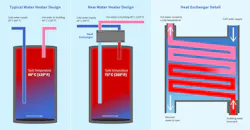
The patented NIST design stores water at approximately 160°F (70°C)—a temperature capable of killing nearly all Legionella almost immediately.
Instead of sending that high-temperature water directly into the plumbing system, the design routes it through a heat exchanger immediately after it leaves the storage tank. The heat exchanger transfers excess heat back into the system while reducing the outgoing water temperature to a safe level before it reaches plumbing fixtures.
Heat Exchanger Improves Safety and Efficiency
Researchers say the integrated heat exchanger offers two key advantages.
First, it recovers heat rather than wasting energy, improving overall system efficiency. Second, the plumbing arrangement prevents occupants from being exposed to dangerously hot water because all water leaving the tank must first pass through the heat exchanger.
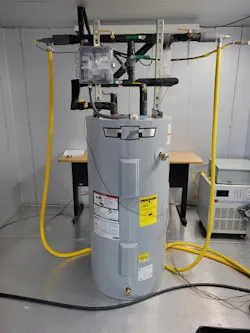
The prototype was created by modifying a commercially available residential water heater.
"We built our residential-size prototype by modifying an off-the-shelf water heater with around $100 of additional components," said Yashar, "and those costs could be brought down by a manufacturer."
While the concept could be applied to residential systems, Yashar expects the greatest benefit to occur in larger commercial and institutional buildings where water management programs are already required to control Legionella growth.
"Hot water is an essential part of everyday life," said Yashar. "It's exciting to bring a new innovation to an old technology."
To learn more about NIST, visit www.nist.gov.
Also in CONTRACTOR: Legionnaires' Disease Outbreak in NYC's Upper East Side